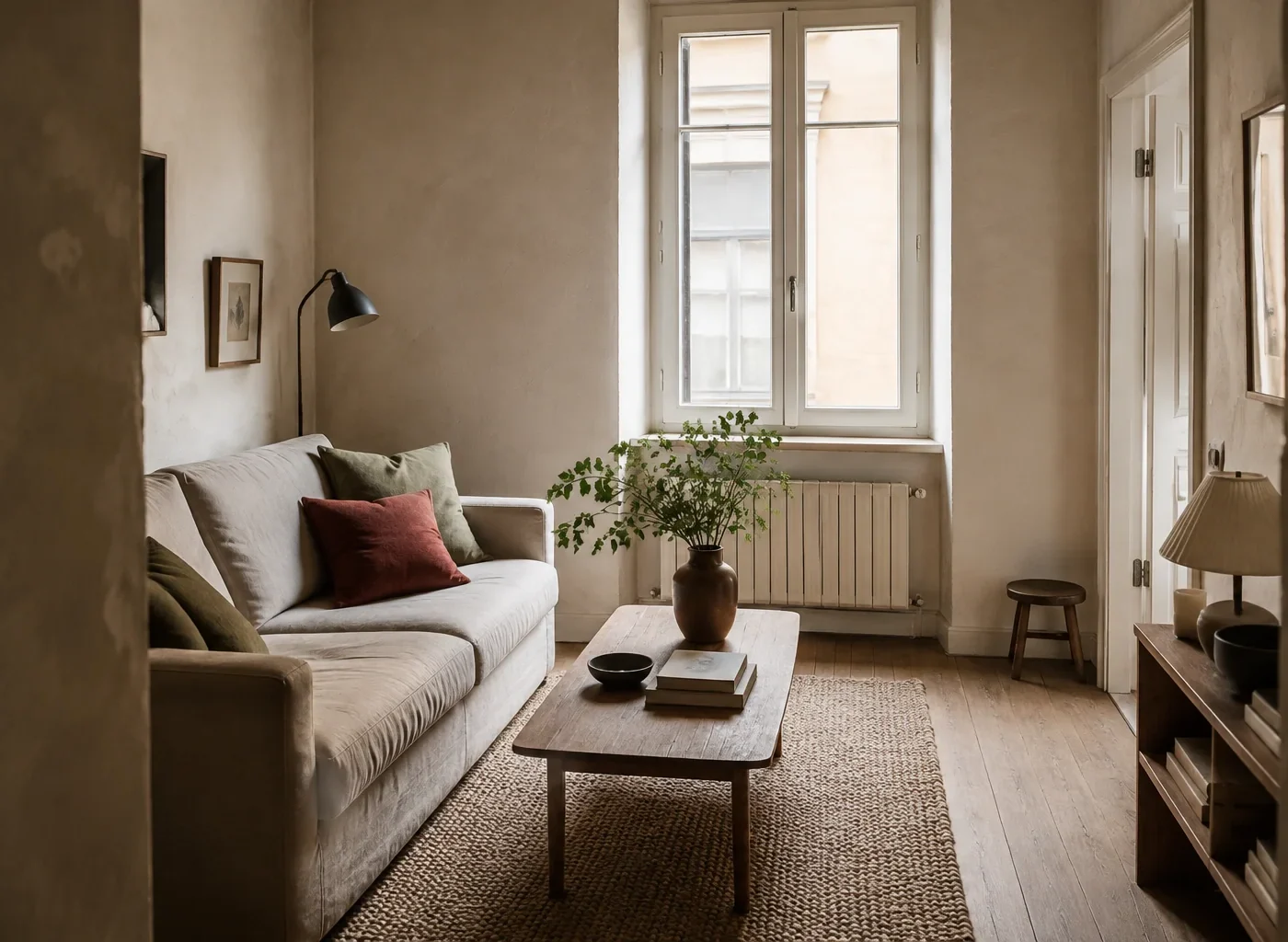
The best small living room ideas are not about making a room look empty. They are about helping it breathe: clear movement, furniture that fits, useful light, and enough personality to make the space feel like home.
Measure the room before you move anything
Draw a simple plan with the room dimensions, doors, windows, radiators, and sockets. Then mark the paths you use most often. A compact room feels crowded when people must turn sideways around furniture, even if the floor plan looks attractive in a photograph.
Leave the clearest possible route between the entrance, seating, and any adjoining room. You may discover that moving a chair by 20 centimetres improves the room more than buying a new storage unit.
Choose one visual anchor
Small rooms still need a focal point. It may be a good sofa, a low bookcase, a piece of art, or the window view. Let one element lead and keep nearby pieces quieter. When every object competes for attention, the room feels busier than it is.
A rug can help define the seating area, but it should be large enough to connect the furniture. A tiny rug floating in the centre often makes the layout feel fragmented.
Buy for proportion, not for the label “small space”
Miniature furniture is not always the answer. One comfortable sofa with visible legs can feel calmer than several undersized chairs. Look at depth, arm width, and the amount of floor visible beneath a piece. Slim arms and raised bases usually give more seating without adding visual weight.
Create breathing room around furniture
Resist pushing every piece against a wall. Even a narrow gap behind a sofa can make the arrangement feel intentional. Keep surfaces partly clear and group small objects on one tray rather than scattering them across the room.
Negative space is part of the design. An unfilled corner or a quiet stretch of wall gives the eye somewhere to rest and makes meaningful objects more noticeable.
Layer the lighting
A single bright ceiling light can flatten a small room. Combine soft ambient light with a reading lamp and, if useful, a small accent light on a shelf. Warm, consistent bulb temperatures help the separate sources feel connected.
Place lamps where the activity happens instead of spacing them symmetrically. A floor lamp beside the reading chair is more useful than one positioned only to balance the opposite corner.
Use storage that earns its footprint
Closed storage is helpful for visually noisy essentials, while open shelves work best for a limited edit of books and objects. A low cabinet can hold practical items, support a lamp, and create a long horizontal line that makes the room feel settled.
Choose dual-purpose furniture only when both purposes work well. A storage ottoman is useful if it is comfortable and easy to open. A complicated transforming table that is awkward every day may add more friction than it removes.
Keep colour calm without losing character
Repeating a small palette across walls, textiles, and larger furniture helps the eye travel smoothly. This does not mean everything must be beige. A muted olive cushion, burgundy throw, or clay-coloured lamp can bring depth when the supporting tones remain connected.
Use texture to create interest: washed linen, wool, oak, ceramic, and woven fibres read as layers without becoming clutter. Vary scale too—one larger artwork is often calmer than a grid of many tiny frames.
A 30-minute reset for a crowded room
- Clear the main walking path.
- Remove objects that belong in another room.
- Leave at least one third of each surface empty.
- Group loose items in a tray, basket, or closed cabinet.
- Turn on the lamps you actually use and move them closer to the task.
- Photograph the room from the doorway to spot visual bottlenecks.
A small living room can be generous when each element supports how you live. Begin with movement and comfort; the decorative details become much easier once the room works.
1 response